***** SMARTS TIME AVAILABLE *****
1.5m time at $250/hour ..... 0.9m time at $500/night
Observing time is available through SMARTS (Small and
Moderate Aperture Research Telescope System) for you or your
institution on the CTIO/SMARTS 1.5m and 0.9m telescopes. Partnerships
can be with institutions, individuals, or groups of individuals. We
also welcome international partners. Time can be purchased for as
little as a few thousand dollars, up to major partners contributing
$50K or more.
The 1.5m is currently equipped with the CHIRON high
resolution spectrograph, described
here. Time is scheduled via service observing runs
carried out by SMARTS staff. Programs may be completed during a
single semester or span several semesters for time-domain science with
highly flexible cadences. The cost is $250/hour.
The 0.9m is currently equipped with an optical
imaging camera with a field of 16.8 arcmin and pixels 0.401 arcsec on
the sky.
See
the SMARTS Overview
for details on the 0.9m telescope and imaging
camera, which have been in operation via SMARTS since 2003. Time is
scheduled for user observing runs (you travel to the telescope in
Chile) that span a few nights or weeks. Time on the 0.9m is
particularly useful for graduate and undergraduate training and
observing experience. The cost is $500/night.
Todd Henry, SMARTS Director --- contact for details about 1.5m and 0.9m observations --- thenry88 [at symbol] gsu [dot] edu
Wei-Chun Jao, SMARTS Deputy Director
1.5m and 0.9m SMARTS Observing Schedules
1.5m Observers --- Key Information
1.5m Details
1.5m SMARTS Results
0.9m Observers --- Key Information
0.9m Details
0.9m SMARTS Results
SMARTS General Information
CTIO General Information
1.5m SMARTS Observing Schedules --- Past
0.9m SMARTS Observing Schedules --- Past
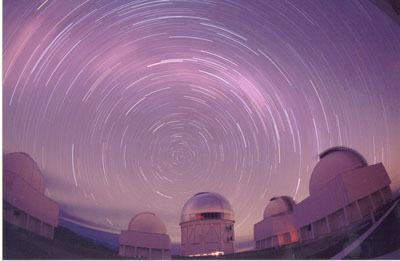
The photo at the top of the page was taken by
Matthias Dietrich on the night of 24 April 2003 using a Canon camera
with 15 mm lens (focal ratio 2.8), exposing for 90 minutes on Fuji ASA
200 film. Three SMARTS telescopes can be seen: the CTIO 0.9m is on the
right, the Yale 1.0m is on the left, and the CTIO 1.5m is second from
the right. The fuzzy reddish region in the upper left and center is
the light from the Milky Way Galaxy.