


Center for High Angular Resolution Astronomy Center for High Angular Resolution Astronomy Center for High Angular Resolution Astronomy
                Center for High Angular Resolution Astronomy


CHARA

  • About
    • CHARA: An Overview
    • The CHARA Consortium
    • CHARA Facility and Instruments
    • Basics of Interferometry
    • CHARA Public Site
    • Mount Wilson Observatory
  • News
    • Science Press Releases
    • Announcements
  • Meetings
    • Annual Science Meetings
    • Community Workshops
  • Research
    • Journal Articles
    • Books and Review Articles
    • Technical Reports
    • Popular Press
    • CHARA Science
  • Observing
    • CHARA Facility and Instruments
    • Applying for Observing Time
    • Planning an Observation
    • Logistics of Observing
    • Observing Schedule
    • Remote Observing
    • Data Reduction Software
    • Data Analysis Software
    • Database
    • Acknowledgments
    • Weather
    • UCSD HPWREN Cameras
    • CHARA Wiki
  • Multimedia
    • Image Gallery
    • Photo Tour of CHARA
    • Videos
    • Mount Wilson and CHARA panorama
    • Drone Panoramas
  • Staff
    • CHARA Team
    • Contacts & CHARA directory

How to Extract OIFITS Data Using IDL Utilities

Download the IDL OIFITS Library - maintained by John Monnier at the University of Michigan.

Inside the IDL OIFITS Library are two test files called testdata.fits and bigtest.fits.  The bigtest.fits contains several tables to demonstrate the full richness of the OIFITS data format, although the values are nonsensical.

Read the OIFITS Tables

The routine "read_oidata" will provide an inventory of the tables contained in the OIFITS file and read in those tables:

IDL> read_oidata, 'testdata.fits', oiarray, oitarget, oiwavelength, oivis, oivis2, oit3, /inventory
This file Satisfies the requirements of the OI_DATA format
Inventory:
OI_ARRAY: 1
OI_TARGET: 1
OI_WAVELENGTH: 1
OI_VIS: 1
OI_VIS2: 1
OI_T3: 1
Unknown Tables: 0

IDL> print, oivis2(0).time, *oivis2(0).vis2data, *oivis2(0).vis2err
82810.000 0.67700000 0.064000000

However, the visibility data are stored as pointers when using read_oidata.  To extract and manipulate the data, use the routines extract_vis2data and extract_t3data described below.

Extract Visibility Amplitudes:

IDL> extract_vis2data, file='bigtest.fits', vis2data

The data are stored in arrays of structures.  To view the contents of the file, use the "help" command with the "/structure" flag:

IDL> help, vis2data, /st
** Structure <1474b28>, 26 tags, length=224, data length=207, refs=1:

OI_REVN INT 1
DATE_OBS STRING 2004-01-11
ARRNAME STRING CHARA_2004Jan
INSNAME STRING  CHARA_MIRC
EFF_WAVE DOUBLE 1.4000000e-06
EFF_BAND DOUBLE 5.0000001e-08 
WAVE_ID INT  0 
TARGET_ID  INT 0
TARGET  STRING 'alp_ori'
RA DOUBLE 0.0000000
DEC  DOUBLE  10.000000 
EQUINOX FLOAT 2000.00
TIME DOUBLE 0.0000000
MJD DOUBLE 0.0000000
INT_TIME DOUBLE 2.0000000
VIS2DATA DOUBLE 0.0000000
VIS2ERR DOUBLE 0.020000000
UCOORD DOUBLE 0.0000000
U DOUBLE 0.0000000
V DOUBLE 0.0000000
SFU DOUBLE 0.0000000
BASELINE DOUBLE 0.0000000
PA DOUBLE 0.0000000
STA_INDEX INT Array[2]
FLAG BYTE 70

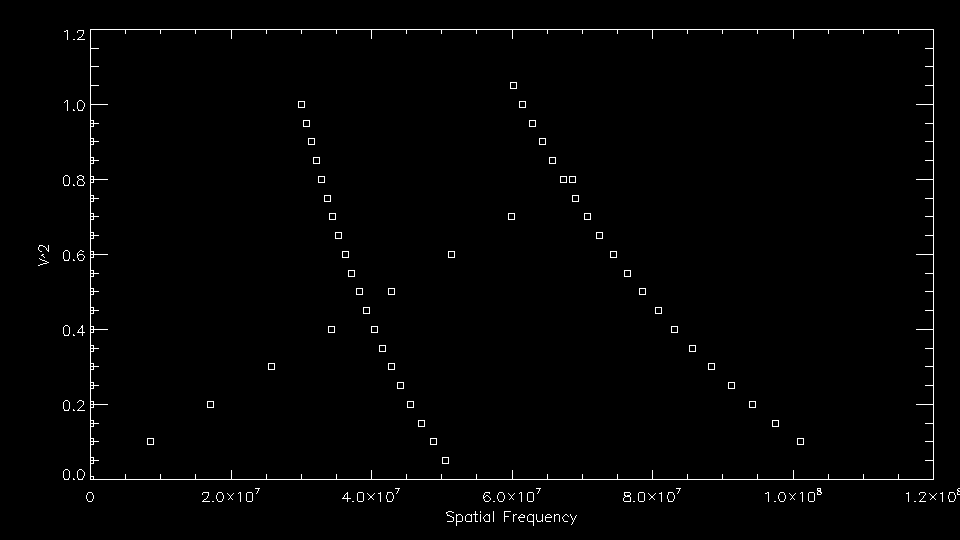
Then you can print, plot, and manipulate any of these arrays as follows:

IDL> plot, vis2data.sfu, vis2data.vis2data, psym=6, xtitle='Spatial Frequency', ytitle='V^2'


Extract Closure Phases:

IDL> extract_t3data, file='bigtest.fits', t3data

The data are stored in arrays of structures.  To view the contents of the file, use the "help" command with the "/structure" flag:

IDL> help, t3data, /st
** Structure <17fc358>, 39 tags, length=328, data length=313, refs=1:

OI_REVN INT 1
DATE_OBS STRING '2004-01-11'
ARRNAME STRING 'CHARA_2004Jan'
INSNAME STRING 'CHARA_MIRC'
EFF_WAVE DOUBLE 1.4000000e-06
EFF_BAND DOUBLE 5.0000001e-08
WAVE_ID INT 0
TARGET_ID INT 0
TARGET STRING 'alp_ori '
RA DOUBLE 0.0000000
DEC DOUBLE 10.000000
EQUINOX FLOAT 2000.00
TIME DOUBLE 0.0000000
MJD DOUBLE 0.0000000
INT_TIME DOUBLE 2.0000000
T3AMP DOUBLE 0.0000000
T3AMPERR DOUBLE 0.020000000
T3PHI DOUBLE 0.0000000
T3PHIERR DOUBLE 0.0000000
U1COORD DOUBLE 0.0000000
V1COORD DOUBLE 0.0000000
U1 DOUBLE 0.0000000
V1 DOUBLE 0.0000000
BASELINE1 DOUBLE 0.0000000
PA1 DOUBLE 0.0000000
U2COORD DOUBLE 0.0000000
V2COORD DOUBLE 0.0000000
U2 DOUBLE 0.0000000
V2 DOUBLE 0.0000000
BASELINE2 DOUBLE 0.0000000
PA2 DOUBLE 0.0000000
U3COORD DOUBLE 0.0000000
V3COORD DOUBLE 0.0000000
U3 DOUBLE 0.0000000
V3 DOUBLE 0.0000000
BASELINE3 DOUBLE 0.0000000
PA3 DOUBLE 0.0000000
STA_INDEX INT Array[3]
FLAG BYTE 70

Then you can print, plot, and manipulate any of these arrays as follows:

IDL> plot, t3data.mjd, t3data.t3phi, psym=6
Time Required for an Observation

A single interferometric observation consists of a calibrator-science-calibrator sequence.  The amount time to collect data on a star depends on the instrument, the seeing, and the brightness of the target.  Here are some guidelines for how long the observations will take:

  • For fast instruments like CLASSIC, CLIMB, JOUFLU, and PAVO, an observation on an individual target will take 5-15 min, so a single CAL-SCI-CAL set will take between 15 to 45 min.  Use the longer integration time for targets near the typical magnitude limit, the shorter integration time for stars ~ 2 mag brighter than the typical limit.
  • For MIRC, an observation on an individual target will take about 30 min, so a CAL-SCI pair will take about 1 hour.
  • For VEGA, an observation on an individual target will take 10-20 min, so a CAL-SCI-CAL set will take 30 min to 1 hour.

Each observation may produce between one to several dozen UV points, depending on how many telescopes are combined and the number of spectral channels in the instrument.  The number of calibrated observations needed to complete a program depends on the science objectives.  The table below gives estimates for the number of observations needed for typical science programs for each instrument:


Beam Combiner Number of Measurements in One Data Set Science Objective Recommended Number of Data Sets
CLASSIC, JOUFLU Each data set consists of one visibility measurement on a single baseline. Angular Diameter ~10 calibrated data sets on each baseline (2.5 - 7.5 hours per baseline).  Observations on two separate nights and on two different baselines are recommended to minimize systematics.  If the star is oblate, then a few baselines at different position angles should be selected.
Binary ~10 calibrated data sets on each baseline (2.5 - 7.5 hours per baseline).  To solve for the binary separation and position angle, then data should be collected on at least two perpendicular baselines.
PAVO Each data set consists of ~ 20 visibility measurements (in each spectral channel) on a single baseline. Angular Diameter 5-10 calibrated data sets on each baseline (2 - 7 hours per baseline).  Observations on two separate nights and on two different baselines are recommended to minimize systematics.  If the star is oblate, then a few baselines at different position angles should be selected.
Binary 5-10 calibrated data sets on each baseline (2 - 7 hours per baseline).  To solve for the binary separation and position angle, then data should be collected on at least two perpendicular baselines.
CLIMB Each data set consists of 3 visibility measurements on each of the 3 baselines and one closure phase. Angular Diameter Obtain ~ 10 calibrated data sets using three telescopes simultaneously (2.5 - 7.5 hours).  Although data is collected more efficiently with CLIMB, the visibility precision isn't quite as good as the 2-telescope combiners such as CLASSIC or JOUFLU. 
Binary Obtain 5-10 calibrated data sets using three telescopes simultaneously (2.5 - 7.5 hours).  In addition to the visibilities, the closure phase measurements provide an additional constraint on the binary separation.
Disks / Imaging Obtain ~ 5 calibrated data sets on each 3-telescope configuration (2 - 4 hours on each configuration).  Select several different 3-telescope configurations to fill in the sky coverage and to sample different spatial frequencies.
VEGA For calibrated V2 observations, each data set provides two visibility measurement on each baseline (one baseline for 2T, three for 3T).  For differential measurements, visibilities and phases are measured as a function of wavelength across the spectral line relative to the continuum. Angular Diameter Obtain ~ 10 calibrated data sets on each selected configuration.
Spectral Studies Obtain a few repeated measurements on the selected configurations.
MIRC-X In H-Prism50 mode, each data set will consist of visibility measurements on up to 15 baselines across 8 spectral channels and closure phase measurements on up to 20 triangles also across 8 spectral channels. Angular Diameters, Circumstellar Disks 3-4 calibrated sets. A diameter or limb darkening measurement could be obtained in a single calibrated snapshot using all 6 telescopes simultaneously.  However, multiple data sets can serve as a check on systematics and visibility calibration.  For the size and orientation of circumstellar disks, multiple data sets are recommended to improve sky coverage. (3 - 4 hours total)
Binary 1-2 calibrated data sets using all 6 telescopes simultaneously (1 - 2 hours).  To solve for the binary position, a minimum of one calibrated 6T data set is required.  However,  to test systematics, two data sets are recommended.  For faint targets or for detecting faint companions, 2-3 sets are recommended to improve the signal-to-noise.
Imaging Complex Sources Imaging stellar surface features or structure within circumstellar disks requires collecting many calibrated data sets on multiple baselines during the night to fill in the sky coverage (~ 1 night per target or the number of hours in a night when the target is above ~ 30 deg elevation).


Companion Detection Limits


There are two ways that a binary star can be observed using an interferometer.  For binaries wider than the coherence length of the beam combiner, the binary will appear as a "Separated Fringe Packet" where a fringe is detected for each binary component.  The separation between the fringe packets gives the binary separation.  For a binary where the separation is smaller than the coherence length, then the two fringe packets from each component will overlap and a modulation can be measured in the visibilities and/or closure phases from the combined fringe packet.  The table below gives the separation range and magnitude sensitivities for binary companions resolvable using different beam combiners at the CHARA Array. 

Combiner

Spectral Mode

Method Magnitude Difference Range of Separations* References
MIRC-X R50 Visibility and closure phase modulation

ΔH < 5 mag (typical performance)

ΔH < 7 mag (best performance)

0.5 - 50 mas  
R100 0.5 - 102 mas  
R182 0.5 - 182 mas  
MYSTIC R49 0.75 - 74 mas  
R100 0.75 - 150 mas  
R278 0.75 - 417 mas  
SPICA LR Visibility and closure phase modulation ΔR < ~3-4 mag (typical performance) 0.2 - 75 mas  
CLASSIC/CLIMB N/A Separated Fringe Packets ΔK < 1.5 mag 8 - 80 mas Farrington et al. (2010); Raghavan et al. (2012)
CLASSIC N/A Visibility modulation ΔK < 3 mag 0.5 - 8 mas Schaefer et al. (2018)
CLIMB N/A Visibility and closure phase modulation ΔK < 2 mag 0.5 - 8 mas  
MIRC N/A Visibility and closure phase modulation ΔH < 6 mag 0.5 - 54 mas Gallenne et al. (2015)
PAVO N/A Visibility modulation ΔR < 3 mag 0.2 - 50 mas  
* The Range of Separations is based on the longest baseline (331 m) assuming the wavelength band identified in the Magnitude Difference column. The outer working angle is calculated by the equation OWA = R*λ/B and the inner working angle is calculated by the equation IWA = 0.5*λ/B  


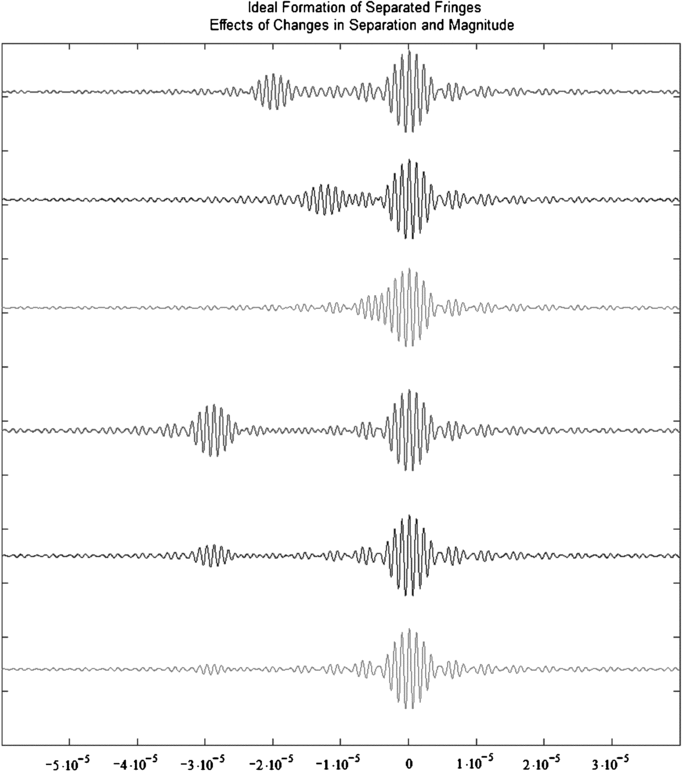
Separated Fringe Packet Binaries

Separated Fringe Packet binaries can be detected by beam combiners like CLASSIC and CLIMB that scan through the fringe window. The minimum separation for this technique is set by the coherence length of the beam combiner given by λ2/Δλ, where λ is the central wavelength and Δλ is the width of the bandpass filter.  The maximum separation is set by the length of the dither scan.

  • For CLASSIC/CLIMB in the K-band (λ = 2.13 μm, Δλ = 0.3489 μm), the coherence length is 13.0 μm.

  • For CLASSIC/CLIMB in the H-band (λ = 1.6731 μm, Δλ = 0.2854 μm), the coherence length is 9.8 μm.

  • For CLASSIC, the short-scan length is 90 μm, medium-scan length is 120 μm, and long-scan length is 150 μm.

The separation in microns [ρ(μm)] can be converted to a separation in milli-arcsec [ρ(mas)] using the formula: ρ(mas) = 206.265 ρ(μm)/B(m) where B(m) is the baseline length in meters.  For the longest 331 m baseline at the CHARA Array using the longest dither scan, separated fringe packets can be measured with separations between 8-80 mas in the K-band.  Companions can be detected down to a magnitude difference of ΔK < 1.5 mag (Raghavan et al. 2012).

Examples of separated fringe packet binaries from Farrington et al. (2010).  The top three scans show the effects of changing the binary separation at a fixed magnitude difference of Δm = 1 mag.  The bottom three scans show the effect of changing the magnitude difference (Δm = 0.5, 1.5, and 2.5 mag) at a fixed separation.  The separation between the two fringes gives the projected separation of the binary along the baseline while the magnitude difference determines the ratio of the fringe amplitudes.

Modulated Fringe Packet Binaries

For binaries with overlapping fringe packets, the minimum separation is set by the resolution of the interferometer and is given by 0.5λ/B, where λ is the wavelength of light and B is the baseline length.  The resolution limit for the longest 331 m baseline at the CHARA Array is 0.20 mas in the R-band, 0.52 mas in the H-band, and 0.66 mas in the K-band.  The maximum separation that can be resolved is set by the coherence length of the beam combiner given by λ2/Δλ, where λ is the central wavelength and Δλ is the width of the bandpass filter. 

  • For CLASSIC/CLIMB in the K-band (λ = 2.13 μm, Δλ = 0.3489 μm), the coherence length is 13.0 μm.

  • For CLASSIC/CLIMB in the H-band (λ = 1.6731 μm, Δλ = 0.2854 μm), the coherence length is 9.8 μm.

  • For MIRC in the H-band (central λ = 1.62 μm, Δλ = 0.03 μm for the width of the 8 spectral channels), the coherence length is 86 μm.

  • For PAVO in the R-band (median λ = 716 nm, Δλ = 6.4 nm for the width of a spectral channel), the coherence length is 80 μm.

The separation in microns [ρ(μm)] can be converted to a separation in milli-arcsec [ρ(mas)] using the formula: ρ(mas) = 206.265 ρ(μm)/B(m) where B(m) is the baseline length in meters. The table at the top of the page lists the range of separations (in mas) that can be resolved by each beam combiner using the longest 331 m baseline

The faintest companion that can be detected using the modulated fringe packet technique can be estimated as follows:

  • For MIRC, Gallenne et al. (2015) determined a dynamic range of 1:200 (ΔH < 6 mag) for binaries with separations smaller than 50 mas.  The precision closure phases measured with MIRC (Zhao et al. 2011) provide good sensitivity to faint companions.

  • For CLASSIC, Schaefer et al. (2018) estimated a maximum magnitude difference of ΔH < 2.9 mag based on a typical 4.5% scatter in the visibilities.

  • For PAVO, an expected 5% precision on the calibrated visibilities would provide sensitivity down to ΔR = 2.7 mag.
Example visibility curve for a binary star. The separation between the peaks in the visibility curve provides a measurement of the binary separation while the minimum visibility reflects the flux ratio between the components

References:

Farrington, et al. 2010, AJ, 139, 2308
Gallenne, et al. 2013, A&A, 552, A21
Gallenne, et al. 2015, A&A, 579, A68
Raghavan, et al. 2012, ApJ, 745, 24
Roettenbacher, et al. 2015, ApJ, 807, 23
Roettenbacher, et al. 2015, ApJ, 809, 159
Schaefer, et al, 2018, ApJ, accepted
Zhao, et al. 2011, PASP, 123, 964

Instructions for setting the beam order.

More Articles …

  1. Timing Information
Page 2 of 3
  • Start
  • Prev
  • 1
  • 2
  • 3
  • Next
  • End
Bootstrap is a front-end framework of Twitter, Inc. Code licensed under MIT License. Font Awesome font licensed under SIL OFL 1.1.